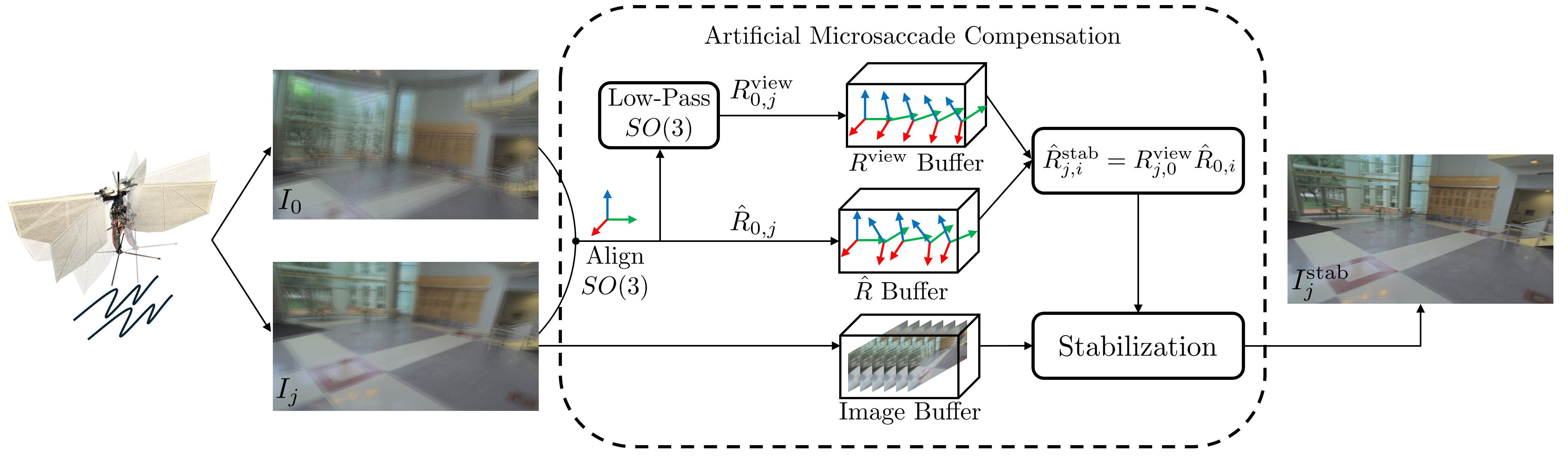
Animals with foveated vision, including humans, experience microsaccades, small, rapid eye movements that they are not aware of. Inspired by this phenomenon, we develop a method for "Artificial Microsaccade Compensation". It can stabilize video captured by a tailless ornithopter that has resisted attempts to use camera-based sensing because it shakes at 12-20 Hz. Our approach minimizes changes in image intensity by optimizing over 3D rotation represented in SO(3). This results in a stabilized video, computed in real time, suitable for human viewing, and free from distortion.